Search This Blog

Saturday, July 17, 2010

Mayan Ednza Archaeological Site 7/6


San Miguel's fortress and museum 7/6

San Miguel's fortress and museum
Beautiful view from the top of the fortress looking out across the ocean.
One of the many pieces of Mayan pottery displayed at the museum.
Jade mosaic mask found in a Mayan tomb.
Examples of knives used by the Mayan priests in the many Mayan religious sacrificial
rights.

Campeche, Campeche Mexico 7/6-7/7

The amazing Sunset over the ocean in Campeche on 7/7
Church on the main plaza in the heart of Campeche.
The streets are lined with Spanish Colonial architecture in these very vibrant and beautiful colors.
Sunset on 7/6. This was the view out of my hotel window!

Monday, July 12, 2010

More up to date blog http://stephskiba.blogspot.com/


As you can tell it has been a challenge for me to keep my blog up to date. Try as I might I never seem to have enough time or internet service to get things updated as often as I would like. One of my travel companions has been much more successful. I am going to give you the link to Stephanie's blog. It will not only give you another prospective of this Mexican adventure, she is much more up to date. I will continue to up load new entries as I can and hopefully will get caught up at some point.

http://stephskiba.blogspot.com/

Bacel/ Panama Hats July 5

On our way to the town of Campeche we stopped off in a small town totally devoted to the weaving of Panama hats. Becal is a small very rustic town. Jacques procured us some local transportation. These three wheel tricycles are used by all the locals to get from one place to another. The whole round trip ride cost us each 10 pecos about a $1.oo. We stopped and visited a gentleman's home and workshop. He had been weaving hats for over 50 years. He gave us a demonstration of how the plant fibers are separated with a needle to make the long fiber threads used to weave the hats. The actual weaving takes place down inside of a cave where the dampness helps to keep the fibers nice and flexible. Up to 10 people would sit down in his small underground cave and weave at the same time. The geography of this part of Mexico makes the ground like Swiss Cheese so that almost all houses come with their own weaving cave. He explained the different grades of woven hats. A true Panama hat takes around 3 weeks to weave and uses only the thinnest finest fibers. Those hats are in the $350.00 price range. Sadly I was unable to purchase any hats. The ones he had for sale that day were either to small or looked really bad on me.
Sculpture of Panama hats in the town plaza.
Bacel's church
Local transportation we took to the hat factory.
The plants on the left are the type used to gather the fibers to make Panama hats
This shows how a needle is used to separate the fibers on each leaf.
A partially woven hat-this is about 1 1/2 weeks worth of work.
We are down inside a cave and this gentleman is demonstrating how to weave a hat. They sit for hours and hours down inside these damp dark caves everyday.

Sunday, July 11, 2010

Merida Day 4 Sisal Plantation 7/5

Today we visited a Sisal plantation that also had several cenotes, one of which we got the chance to swim in. At one time the Sisal industry made this part of Mexico a very prosperous place. The fiber from the Sisal plant is very strong. It was very interesting to learn the process of how sisal is harvested and processed into the fiber. The plant takes 7 years to grow big enough to harvest leaves from. Once the plant is 7 years old 10 leaves are cut from it twice a year for approximately 25 years. Around 25 years the plant shoots up a large stock from the middle which signals that the plant is going to die. Sisal plants grow very well in the infertile limestone soil of the Yucatan. They do not require any special care or fertilization.

The plants which Sisal is harvested from.
They comb the fibers to spin it into twine and then make the twine into ropes.
Bundles of leaves are put on this conveyer belt and brought up to the machine that strips the outer husk
Preparing the leaves to be stripped and the fiber gathered.
The wet Sisal fiber.
Bales of Sisel fiber.
This machine takes the dried Sisel and puts into a bale.
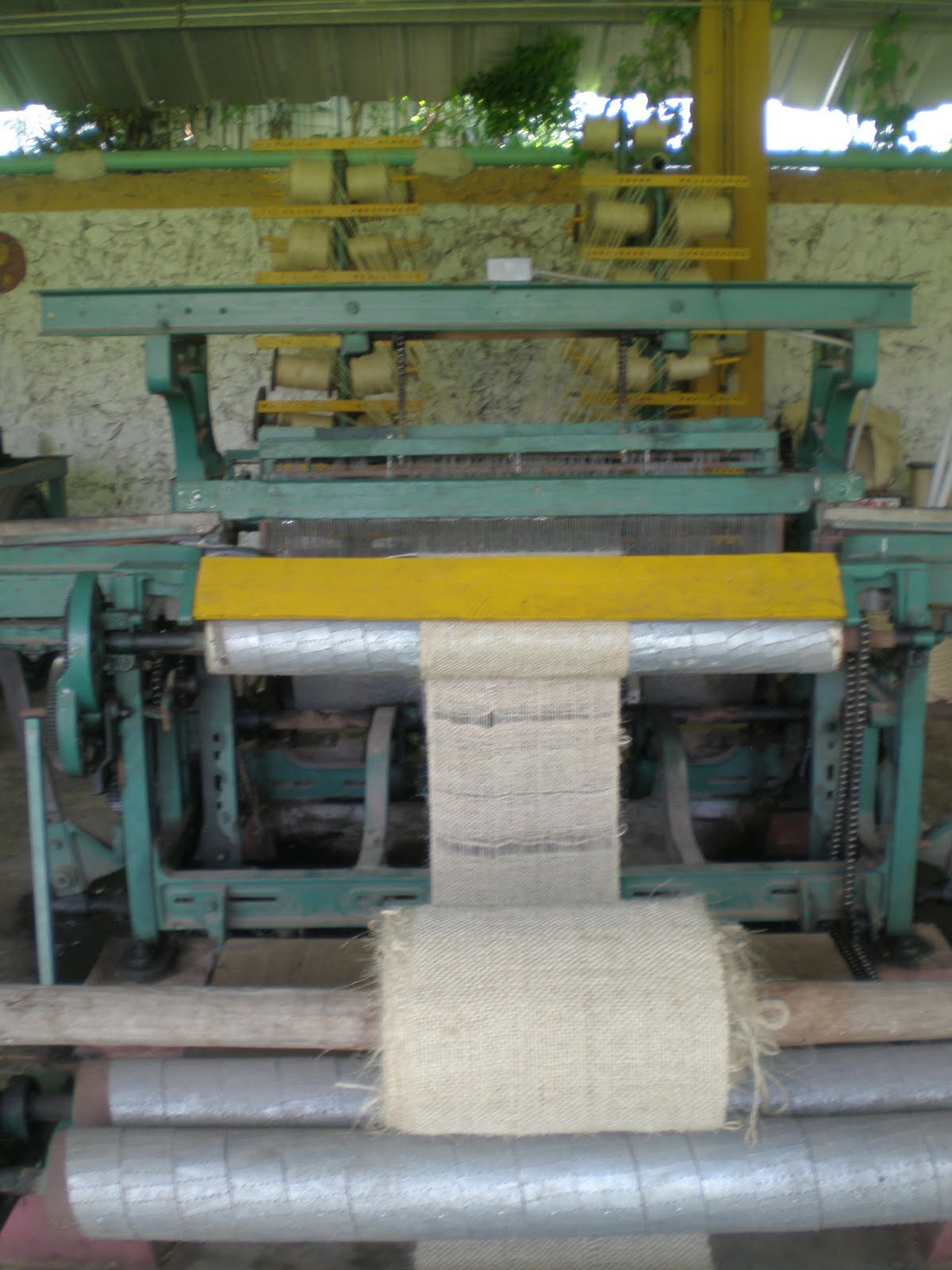
This machine takes the processed Sisal fiber and makes it into burlap that can be used for carpet backing or burlap bags.
This machine turns the processed Sisal fibers into ropes.
This picture reminds me of a Degio Rivera Painting.

Merida Day 3 Celestun Beach-July 4

On our trip to Celstun July 4th we were suppose to get to see a flock of flamingos. Unfortunately, the tide was high and they were nowhere to be seen. However, we did get to take a boat ride and see the coastline, which was breathtaking. We also stopped and visited a wetland area and saw mangrove trees. The area we visited had several trees that had been killed by a past storm and had become mummified by the salt water.
After the boat ride we had a nice seafood lunch at a local restaurant. I had my first ever crab tacos. Yum